
-

Yamaha YUS5 SH3 Silent Upright in Polished Ebony
£15,895.00 -

Yamaha YUS3 SH3 Silent Upright in Polished Ebony
£14,495.00 -

Yamaha YUS1 SH3 Silent Upright in Polished Ebony
£13,895.00 -

Yamaha YU3S Silent Upright, 1999 (Refurbished)
£7,995.00 -

Yamaha U3S SH3 Silent Upright in Polished Ebony
£13,795.00 -

Yamaha U3H Silent Upright, mid 1970’s (Refurbished)
£5,295.00 -

Yamaha U3 Silent Upright, Around 1970 (Refurbished)
£4,995.00 -

Yamaha U1H Silent Upright, mid-late 1970’s (Refurbished)
£4,795.00 -

Yamaha U1A Silent Upright, late 1980’s (Refurbished by Yamaha)
£6,495.00 -

Yamaha U1 SH3 Silent Upright in Polished Ebony
£11,795.00 -

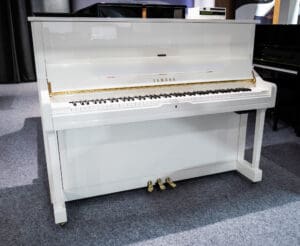
Yamaha U1 Disklavier Silent Upright in Polished White, 2006
£7,995.00 -

Yamaha SU7 Upright SH Silent in Polished Ebony, 2018
£16,995.00



Silent Pianos for everyone.
Silent Pianos
Silent pianos
Want to play a real acoustic piano at any hour without disturbing anyone? A silent piano is an upright or grand with a system that stops the hammers just short of the strings, so you can play through headphones instead.
At Richard Lawson Pianos, we stock new and pre-owned silent pianos from Yamaha and Kawai, from compact uprights for practising at home to full-size grands. Every one comes with a 5-year guarantee and no-quibble returns.
If you’re not completely happy, you have a 30-day trial in which you can change your mind.
What is a silent piano?
In normal mode, a silent piano is a fully strung acoustic instrument. The hammers strike the strings exactly as they would on any other upright or grand piano.
You usually engage silent mode with the middle pedal. A rail then moves in front of the hammers and stops just short of the strings, so the keys move as normal but the strings stay silent.
Sensors track how you play each key, and a sound module turns that movement into a sampled piano sound that you hear through headphones.
Switch silent mode off, and it plays as a normal acoustic piano again. That’s why silent pianos are often described as bridging the gap between the desire for a ‘real’ piano and the practicality of a digital piano.
How do Yamaha and Kawai silent systems differ?
Both brands fit the silent system to their new pianos at the factory. The differences are in how each one reads your playing, where its headphone sound comes from and how you adjust its settings.
Yamaha’s current systems are SH3 and SC3. You’ll find SH3 on pianos such as the U1, U3, YUS series and C series grands. SC3 comes on the more affordable b and B series uprights and the GB1K grand.
Both use non-contact sensors under the keys that track each key’s movement continuously. Yamaha grands with SH3 also have sensors on the hammers to pick up very slow keystrokes and fast trills.
Through the headphones, you hear samples of Yamaha’s CFX concert grand and the Bösendorfer Imperial.
Kawai’s current system is AnyTime ATX4. It’s available on models including the K200, K300 and K500 uprights and the GL10, GL30 and GX2 grands.
Rather than reading the keys, ATX4 uses optical sensors on the hammers, which Kawai calls its Integrated Hammer Sensing System. Its main piano sound comes from samples of the Shigeru Kawai SK-EX concert grand.
You adjust its settings through Kawai’s PianoRemote app on a phone or tablet, and it has Bluetooth MIDI and audio built in.
The silent system is only part of the decision. Whenever silent mode is off, you’re playing the acoustic piano underneath, so we’d always suggest trying both brands in the showroom.
You can browse each range on our Yamaha silent pianos and Kawai silent pianos pages.
Silent piano or digital piano?
A digital piano makes all of its sound electronically. A silent piano is still a fully strung acoustic piano, with digital playback added for when you need it.
That means you get a real acoustic action under your fingers rather than a weighted keyboard built to imitate one. Without headphones, the sound comes from strings and a soundboard, not speakers.
A silent piano also needs tuning like any other acoustic piano, which a digital piano doesn’t. It costs more too, both than the same model without a silent system and than most digital pianos.
If you only ever plan to play through headphones, a good digital piano may be the better buy. If you want an acoustic piano with the option to play quietly, a silent piano gives you both in one instrument.
Should you buy a second-hand silent piano?
It can be good value, as long as you listen to it first. Our pre-owned silent pianos range from recent models to refurbished instruments that are several decades old.
Older silent systems use earlier sensors and sound modules than the current generation. Listen through the headphones as well as acoustically before you decide.
Refurbished silent pianos go through our 113-point check before they go on sale. They come with a 5-year guarantee, which covers the piano but not the silent system.
You can view our pre-owned silent pianos here. The website shows only part of our stock, so ask the team about others in the showroom.
Can a silent system be added to a piano?
Often, yes. We’re agents for PianoDisc, AdSilent and Genio silent systems, and our trained technicians can fit these to the upright and grand pianos we sell.
Find out more about retrofitted silent systems, or ask the team whether one would suit a piano you already own.
How much does a silent piano cost?
The price depends mainly on whether it’s an upright or a grand, whether it’s new or pre-owned, and which model the system is fitted to.
Refurbished silent uprights in our current stock start at under £5,000. A new Kawai K500 ATX4 is £10,995 and a new Yamaha U1 SH3 is £11,795, while new silent grands such as the Yamaha C5X SH3 cost over £40,000.
We offer 0% finance on many of our pianos, subject to terms and conditions, and part exchange if you have a piano to trade in.
What headphones can I use with a silent piano?
New Yamaha and Kawai silent pianos come with a pair of headphones. Yamaha’s SH3 and Kawai’s ATX4 systems both have two headphone sockets, so a teacher and pupil can listen at the same time.
Yamaha’s SH3 uses standard 3.5 mm stereo mini jacks. Any good-quality pair of your own will work, as long as the plug fits the socket or you use an adaptor. Many pianists prefer over-ear headphones for long practice sessions.
Does a silent piano still need tuning?
Yes, a silent piano has the same strings, soundboard and action as any other acoustic piano. It needs regular tuning and servicing even if you mostly play through headphones.
The headphone sound is digital and won’t go out of tune, but the acoustic sound drifts over time like any other piano’s.
Can I play a silent piano at night or in a flat?
Yes, with silent mode on, you hear the piano through headphones, and the people around you hear only the quiet knock of the keys and action.
That makes it a practical choice if your neighbours complain easily, or you work shifts and can only play at night.
It also suits anyone who stumbles over their notes if they think someone is listening, or would rather practise in private with no distractions.
And if it’s the kids who are learning, you won’t have to sit through scales on repeat or yet another rendition of ‘The Entertainer’.
Where can you try a silent piano?
The Richard Lawson Pianos showroom has more than 200 new and refurbished pianos, and it’s open by appointment from 8am to 10pm, seven days a week.
You can try Yamaha and Kawai silent pianos side by side there, both acoustically and through headphones, before you decide.
Want to hear both systems first? Book a showroom visit: call 01923 720 974, email info@richardlawsonpianos.com or use the contact form.
Richard Lawson Buyer's Guide
Download our brand new Buyer’s Guide to help you find your dream piano
 Reviews


