
The best upright piano is the one that suits the player in front of it and the budget behind it, so this guide picks the uprights worth shortlisting. Whether you’re buying for a child working through grades, coming back to the piano after years away or ready to step up from a first instrument, there’s a section here to help. A well-refurbished piano is often the smarter buy, and you can browse the full range of upright pianos to see what’s in stock today.
How to choose an upright piano
Three things decide which upright suits you: height, touch and budget.
Height
Height matters because a taller piano usually has longer strings and a larger soundboard, which you hear as a fuller, deeper bass and a tone that carries further. A compact piano, such as the 109cm Yamaha B10, sounds lighter but fits almost anywhere.
Touch
Touch is how the keys feel under your fingers, how much they resist and how evenly they return, and a good action lets you play softly and quickly without effort. This is why you should play two or three pianos before you decide, because no specification sheet can tell you how a piano feels to you.
Budget
The budget often follows from the other two, and beginners don’t need the most expensive model. What they do need is 88 keys and a properly regulated action, which means the keys respond evenly and the hammers strike the strings the same way each time.
First uprights for beginners and family homes
The Yamaha B10 is the usual first choice for a family home. It stands 109cm tall and is built in China. A new B10 SC3 silent upright currently costs £5,145, and a pre-owned b1 SG2 silent upright was listed at £3,795. Its action is light and forgiving for small hands, so it suits a child starting lessons, and its limitation is the compact cabinet, which gives a lighter bass than any taller piano can. The silent version lets you practise with headphones. You can read more about our silent pianos on our website.
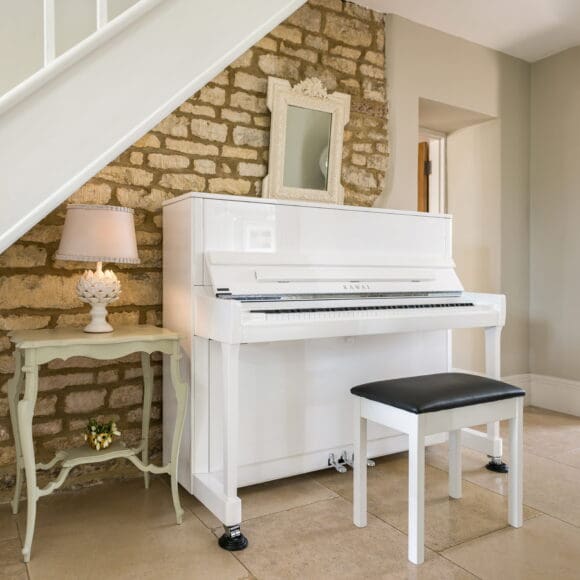
The Kawai K15 is the compact Kawai to look at alongside it, and it’s where our Kawai upright pianos begin. At 110cm, it’s almost the same size as the b1; a new one currently costs £3,095, and it suits families and first-time buyers who want a Kawai without a large cabinet. It also comes in a silent ATX3 version, and its limitation is the same as the B10, since at this height you give up some depth in the bass. We don’t currently list a refurbished K15 to compare, so for a taller piano at a similar price, read on.
Whichever you choose, ask to play it at the height of your own stool, and for a child to check that they can reach the pedals comfortably.
The step up: Yamaha U1 or U3, Kawai K300 or K500
Most improving players and many families end up choosing between the Japan-built Yamaha U1 and the Yamaha U3, and the difference is height. The U1 stands 121cm, and the U3 131cm, and the extra 10cm gives the U3 a larger soundboard and longer strings, which you hear as more power, a deeper bass and better projection in a bigger room. If you’re returning to the piano, the U1 is usually the easier fit for a typical living room, while the U3 suits a larger space or a player who wants more resonance.
The cost is space and money. A new U3S is currently £10,845, while our refurbished U3s run from £3,995 to £9,995 and refurbished U1s start at £3,295; new U1 prices are on the U1 page. A refurbished U3 can cost less than a new Kawai K300 at £4,645, and a Japan-built Yamaha that has been refurbished and carries the 5-year guarantee is often better value than a new entry-level piano.
The Kawai K300 stands 122cm and has a clear, balanced tone, while the K500 stands 130cm, currently costs £7,845 and has a richer, more resonant sound, with the K300 limited by its smaller cabinet and the K500 by its price. We compare them in full in our guide to the Kawai K300 or K500.
Professional and premium uprights
Professional uprights are for players who can hear and use the difference, such as advanced students, teachers and anyone who practises for hours a day. For most beginners, they’re more piano than is needed. The Yamaha YUS1 and YUS3 are the natural next step from the U series, built in Japan at 121cm and 131cm with hand-finished cabinets. New, they currently cost £10,995 and £12,995, while refurbished examples from 2007 and 2008 are £8,595 and £7,995.
Petrof upright pianos such as the 125 F1, at 125cm and currently£10,995 new, have a powerful yet gentle tone. A refurbished 2008 Bechstein A124 at 124cm is £11,995, and among Steinway upright pianos, a 132cm Model K from 2014 is £32,995.
Is Yamaha better than Steinway? They’re built to different standards and priced accordingly, and the Steinway is what most people mean by the Rolls-Royce of pianos, so play both before deciding whether you’d hear a difference worth paying for. If you’re considering this level, hear a YUS3 next to a refurbished U3 first, because it shows what the extra money buys.
Which brand of upright piano is best?
No brand is best for everyone, and each is known for something different. Yamaha uprights are known for consistency, with an even tone and dependable build, and the U series is built in Japan. Kawai uprights are known for a clear, balanced tone with the K300 and a richer one with the K500. Petrof uprights are known for a tone that’s powerful but gentle. Steinway uprights are the flagship, with the Model K the one players aspire to. None of these is a wrong choice, so go back to the level that fits you and play two or three, and the right one is usually the one you keep returning to at the keyboard.
New or refurbished?
A refurbished upright from us has been through a 113-point check before it goes on sale, carries the same 5-year guarantee as a new piano and comes with a 30-day trial, so you aren’t taking a chance on a piano with a history.
Many of our Yamahas date from the Golden Age of Japanese piano building, in the 1970s and 1980s, when everything was made in Japan, and they’re known for staying in good order for decades. You can browse our pre-owned pianos, and for more on which makes are suitable for beginners, read our guide to used piano brands for beginners.
If you’d like to try before you buy, our piano hire starts from £50 a month depending on the piano for a minimum of 6 months, and you can spread the cost with our finance options, with 0% finance on many of our pianos, subject to terms and conditions.
Try them side by side
Want to test your shortlisted pianos side by side? Book a showroom visit. The Richard Lawson Pianos showroom is open by appointment from 8am to 10pm, 7 days a week, and you can try the uprights above among our upright pianos before you decide. Take some measurements at home and bring the height of your space, and we’ll show you what fits.
Call 01923 720 974, email info@richardlawsonpianos.com or use the contact form.








 Reviews


